
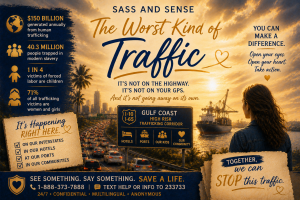
THE WORST KIND OF TRAFFIC
It’s not on the highway. It’s not on your GPS. And it’s not going away on its own.
We’ve all been there. Sitting white-knuckled in bumper-to-bumper traffic, watching the clock tick, wondering where all these people came from and where on earth they all think they’re going. Traffic is everywhere. Too many people, too many places, too little road, and none of it moving the way it used to.
That’s a real problem. But it’s not the car traffic I came here to talk about today.
Over the past couple of years, I’ve been exposed to the facts of human trafficking. Really exposed, not just a headline-scroll. God has put this on my heart by bringing people into my life that are firsthand warriors, working to save young children from lives of horror. It has cut me to the core. When you really look, and listen, you will find out that it is happening in your neighborhood, right under your nose. It doesn’t feel possible. Except it is. It’s happening right now, today, and it’s a whole lot closer to home than most of us want to admit.
So here I am, sharing it with you. You’re welcome. And I’m sorry.
Before you tell yourself this is a faraway problem happening in some other country to some other people — stay with me. Because it is happening right in our own backyard. On our interstates. In our hotels. At our ports. And yes, in the communities we drive through every single day along the Gulf Coast.
| Unfortunately, or fortunately, once you know, you can’t unknow it. So let’s get uncomfortable together. |
The global picture — and it is ugly
Human trafficking is the second most profitable criminal industry in the world, right behind drug trafficking. Let that sit for a second. We’re not talking about something small or obscure. We’re talking about a $150 billion-a-year machine built entirely on the exploitation of human beings.
| 40.3 million | people are trapped in modern slavery at any given point in time |
| $150 billion | generated annually through forced labor worldwide |
| 1 in 4 | victims of forced labor are children |
| 71% | of all trafficking victims are women and girls |
These are not distant statistics. These are supply chains. These are the factories producing the things we buy and the fields growing the food we eat. Which brings me to the part nobody wants to talk about at the checkout line.
Your discount haul has a hidden receipt
Fast fashion and discount goods are deeply tangled up with forced and child labor. When a shirt costs six dollars and still turns a profit after shipping, marketing, and retail markup, somebody’s labor was not paid for fairly. Or at all. I am guilty of buying discount goods myself, and it seems too good to resist. But the reality is brutal. And knowing this convicts me to behave differently, and to inform others that we can’t tolerate such, and we are not supposed to profit from other’s slavery and mistreatment. I truly could not believe the true statistics, that this many people are using innocent lives to violate, and abuse, simply for a dollar. Actually for billions of dollars. How can they have no conscience?
The U.S. Department of Labor keeps what’s called the TVPRA list, a running catalog of goods produced by child labor or forced labor around the world. Right now, it names over 160 goods from 77 different countries. We’re talking garments, electronics, cocoa, cotton, bricks. Things we use every day.
Countries that show up repeatedly include Bangladesh, Cambodia, India, China, and large parts of West Africa. Children as young as five years old are documented working in garment factories, brick kilns, and cocoa farms. Sometimes they are trafficked from their own villages by people who promised their families a better opportunity. A job. Or a future. And instead delivered a nightmare. Actually, some parents are pimping out their own children for money. Yes, that’s actually a story of a girl that is in a rescue foster facility here in Alabama. Trampled and torn, but hopefully can be restored with love and mercy. I only know there are hundreds of thousands more that haven’t been rescued. It literally breaks my heart.
| When we buy without asking questions, we fund systems that don’t have to answer them. |
That doesn’t mean you have to throw out your entire wardrobe tomorrow. It means we start asking: who made this? What do I actually know about where this came from? Apps like “Good On You” and the “Know The Chain” benchmark exist precisely because some consumers got fed up and started demanding answers. We can be those consumers. We cannot buy and continue to fund prostitution and slavery.
Now let’s talk about right here — Gulf Coast, Alabama
Think trafficking only happens in big cities or at international borders? Think again. Alabama, and the Gulf Coast in particular, has been consistently flagged as a high-risk corridor by federal and regional task forces. This is not abstract. This is our backyard.
| Top-ranked | Alabama ranks among the highest in the Southeast for trafficking reports per capita |
| I-10 & I-65 | Major trafficking corridors running directly through Baldwin and Mobile counties |
| Hotels & ports | Gulf Coast tourism infrastructure and the Port of Mobile are known exploitation hotspots |
| 80%+ | Of identified victims in Alabama are U.S.-born citizens, not foreign nationals. Our own kids!! |
The National Human Trafficking Hotline has received hundreds of calls and tips from Alabama over the past decade alone. Mobile and Baldwin counties are specifically named in Southeast regional task force reports as high-activity areas. The reasons aren’t complicated: Interstate corridors make movement easy, the Port of Mobile creates opportunities for labor trafficking, and the tourism economy along the coast provides cover.
And here’s the thing that stopped me cold when I first learned it: most victims identified in Alabama are American. Born here. Not someone trafficked across an ocean. Your neighbor’s kid. Someone’s cousin. A teenager who answered the wrong message online. It’s real. It hits home. Every day.
| In Alabama, trafficking takes many forms. Agricultural workers, domestic workers, and people in the seafood and hospitality industries along the coast are especially vulnerable, and they are frequently invisible to the systems that are supposed to protect them. |
Local organizations like Crisis Services of North Alabama, the Alabama Law Enforcement Agency’s Human Trafficking Task Force, and STOP (Stop Trafficking On People) are doing this work every day — often underfunded, often overwhelmed, and never getting enough credit for it. Also, Camille Place and Samuel’s Place, who are the only facilities in Alabama to bring these victims in to begin rehabilitation, and love. Some of these children have been in slavery for their whole lives and have never known a birthday celebration. Some have come to these homes pregnant, 13 years old, about to be a parent to a baby they were raped to deliver.
What you can actually do, for real, not just share a graphic
1. Learn the signs. Trafficking doesn’t always look like chains. It looks like someone who won’t make eye contact, who has someone else speaking for them, who seems confused about where they are or doesn’t know their own address. It looks ordinary, which is exactly why it gets missed.
2. Support local organizations. Donate to or volunteer with groups working trafficking cases in Alabama. Follow the Alabama Human Trafficking Task Force for current updates and ways to get involved.
3.Ask about your supply chain. Before your next big haul, spend two minutes searching the brand name alongside the words ‘forced labor.’ You don’t have to be perfect. You just have to be more aware than you were yesterday.
4.Report what you see. You don’t need to be certain something is trafficking before you call. That’s literally what the hotline is there for. Report it and let the people trained for this sort it out.
5. Volunteer or donate to those who are working hard to protect victims. Partner to make a bigger difference. Not to guilt you into it, but be led to not sit idly by while these businesses grow. You can make a difference. Camille
| National Human Trafficking Hotline 1-888-373-7888 | Text HELP or INFO to 233733 Available 24 hours a day, 7 days a week. Confidential, multilingual, and anonymous. |
Sources: International Labour Organization (ILO) 2022 Global Estimates of Modern Slavery; U.S. Department of Labor TVPRA List of Goods Produced by Child Labor or Forced Labor; National Human Trafficking Hotline State Data; Alabama Law Enforcement Agency Human Trafficking Task Force; Polaris Project State Report Cards.